


Around the time my father's father died, I was doing a deep dive on Wagner.
I read a good translation of the Ring of the Nibelung and I understood several things, but one thing really stuck with me.
The whole drama, the whole goddamn thing, starts with an imbalance of the sort I described in this post.
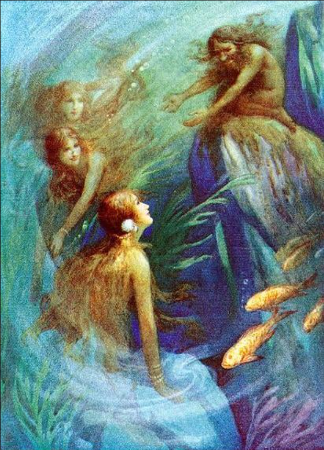
The Rhinemaidens are there to protect daddy's gold. There's too much masculine. All the feminine figures are basically property. This is problem numero uno, the setup for the story.
I look around and I see Rhinemaidens everywhere. They're usually at boba tea places. I was like that as a teenager, too – well-cared for because I was supported by and supportive of my father and the things he valued. I resented being in a value system that was entirely about the masculine (churrrrrrrrch), but so did he, and I became kind of a tech Valkyrie because I loved my dad and that was where the value was.
So these Rhinemaidens are not in touch with the feminine. They're out of whack and orienting around just one thing. And when Alberich the dwarf paddles on in and falls for them, they are not kind. They tease him and they make fun of his arousal. It's not cool.
That is my most important lesson from the whole story – using your sexuality or your status as a weapon to diminish someone else is never okay.
Now here's where the dwarf does his part. He feels rejected (and rightly so, it doesn't matter that he's a dwarf, he still deserves respect). But with those feelings he casts a magical spell called the "denial of love" and puts that spell on the ring he forges.
That's what the ring carries.
But there's a specific sequence, and a specific series of decisions, that leads to the making of that ring. I try to apply those understandings on a regular basis and to make sure that my values are not oriented around wealth, property, endless achievement (for starters). I look at where my money's coming from. I want to be gentle and honest in my dealings with others. I don't need to be too glossy.
Jean Shinoda Bolen discusses this story in some beautiful ways. She says that when we are not loved, we settle for power, and she imagines a world where we value power with instead of power over.
What does a story look like when you choose love over power?


Member discussion